
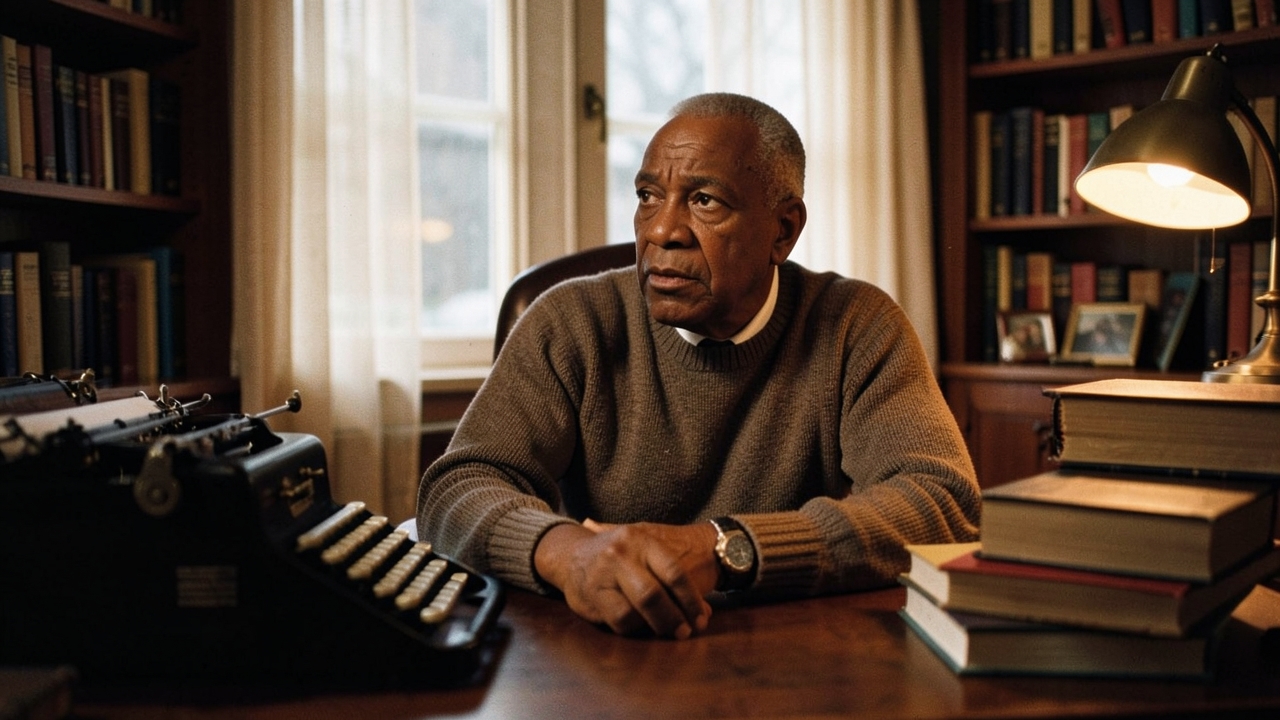
What happens when the private weight of a life becomes the sharpest lens for examining a public world? How does one transform the texture of a father’s rage, the geography of a Harlem street, or the ache of being both American and exiled into a precise instrument for dismantling social myths? This is the enduring, haunting question at the heart of James Baldwin’s work. It is the engine of his masterful collection, Notes of a Native Son, where the James Baldwin personal narrative is not mere confession, but a meticulously calibrated social X-ray. He did not simply tell us about his life; he used its fractures to illuminate the fault lines of a nation. For the writer, Baldwin’s practice offers a profound lesson: the most potent political statement may be the most unflinching personal truth.
The Architecture of the Personal Lens
Baldwin’s genius lies in his rejection of the false dichotomy between the personal and the political. For him, they are a single, inextricable fabric. His personal narrative operates not as a parallel to his social criticism, but as its very foundation. In the opening essay, “Autobiographical Notes,” he declares his vocation: “I write in order to find out what I am thinking, what I am looking at, what I see and what it means.” This is the essential alchemy. The self becomes the laboratory where societal poisons are isolated and examined.
Technique 1: The Anecdote as Evidence
Baldwin never argues in the abstract. He presents a lived moment—a dinner date interrupted by racial violence in “The Harlem Ghetto,” the suffocating visit to his father’s funeral in “Notes of a Native Son”—and then expands its circumference. For example, in the latter essay, he doesn’t just describe a personal encounter with prejudice in a New Jersey restaurant. He traces that moment back through history, connecting the waiter’s hatred to the legacy of slavery and the American founding. The personal anecdote becomes irrefutable, visceral evidence in a larger indictment. As the literary critic Hilton Als notes, Baldwin “makes the personal a form of public history.”
Technique 2: Emotional Truth as Analytical Tool
Other writers of social criticism might rely on statistics and policy analysis. Baldwin trusts emotion. He conveys the psychological toll of systemic racism with a novelist’s precision. The simmering, volcanic anger he describes in “Stranger in the Village” isn’t just autobiography; it’s a diagnostic tool. It maps the internal landscape created by a world that denies your humanity. Consequently, the reader doesn’t just learn about prejudice; they feel its corrosive, daily weight. This approach resonates with the work of later writers like Claudia Rankine, whose Citizen similarly uses poetic vignettes of personal experience to expose the micro- and macro-aggressions of racism.
Why the James Baldwin Personal Narrative Endures
Baldwin’s method offers a timeless blueprint for the writer seeking to bridge the intimate and the epic. In an age of polarized discourse, his work reminds us that systemic critique must be rooted in human reality. To critique a social structure, one must first articulate the human experience within it. Therefore, Baldwin’s legacy challenges us to ask: What structures are invisibly shaping the intimate moments of our own lives?
Furthermore, his technique prefigures the modern “autocriticism” seen in writers like Carmen Maria Machado or Ocean Vuong, who similarly use the body and memory as sites of cultural analysis. The personal narrative, in Baldwin’s hands, becomes an act of resistance. By insisting on the complexity and dignity of his own inner world, he defies the simplistic, dehumanizing narratives that uphold oppression. He makes it impossible to look away from the person, and therefore, from the society that produced their pain.
A Case Study: “Notes of a Native Son”
The rain began as I stepped outside. A cold, persistent drizzle that mirrored the gray silence of my father’s house, where his body lay in the front room. He was dead, and I could not mourn him. The world outside was more alive than he had ever been allowed to be. It was alive with its petty cruelties and its vast, indifferent machinery. I went to a restaurant, a place of clean light and white faces. “We don’t serve Negroes here,” the waitress said, her voice flat. It was not a surprise. It was the city’s heartbeat, a rhythm I knew intimately. My father’s world had been built of such moments. A fortress of rage, constructed brick by silent brick from every slight, every closed door, every lowered eye. I hated him for that fortress, for the way it had walled us in. Now, standing on a street corner in the rain, watching a small riot erupt—a store window shattering like a sudden scream—I felt a terrible understanding. His rage was not his alone. It was the city’s. It was history’s. It was mine. The fire in the store was a mirror. In its light, I saw not just my father’s funeral, but the funeral of every hope that America had ever promised and betrayed.
Learning from the Master
For the contemporary writer, Baldwin’s example is a charge to dig deeper. It urges us to mine our own experiences—not for narcissistic indulgence, but for clarity. Ask yourself: what personal memory reveals a larger truth about power, history, or identity? How can the specific texture of a family conflict illustrate a cultural divide? Baldwin shows that the journey inward is not an escape from the world, but the most courageous way to engage with it.
His work sits in conversation with the gothic personal critiques of writers like Shirley Jackson, who used domestic unease to explore societal conformity, and the raw, historical introspection of literary memoirists who follow in his wake. To write with this level of integrated purpose requires immense courage. It means refusing to separate the heart from the head, the story from the argument. It means understanding that the most profound social structures are often built within the architecture of our own hearts.
Therefore, the challenge Baldwin leaves us is not merely to write beautifully about the world, but to use the mirror of our own narrative to bend its light toward its hidden corners, to make the invisible painfully visible. If the personal is indeed political, then the writer’s most honest notebook is also a nation’s most urgent manifesto. And so we must ask ourselves: what is our personal truth, and what society does it, in its unvarnished state, dare to indict?
For further exploration of narrative voice, see our essay on The Gothic Narrative Voice, or examine how other masters blended the personal with the political in our piece on Daphne du Maurier’s Use of Setting.