
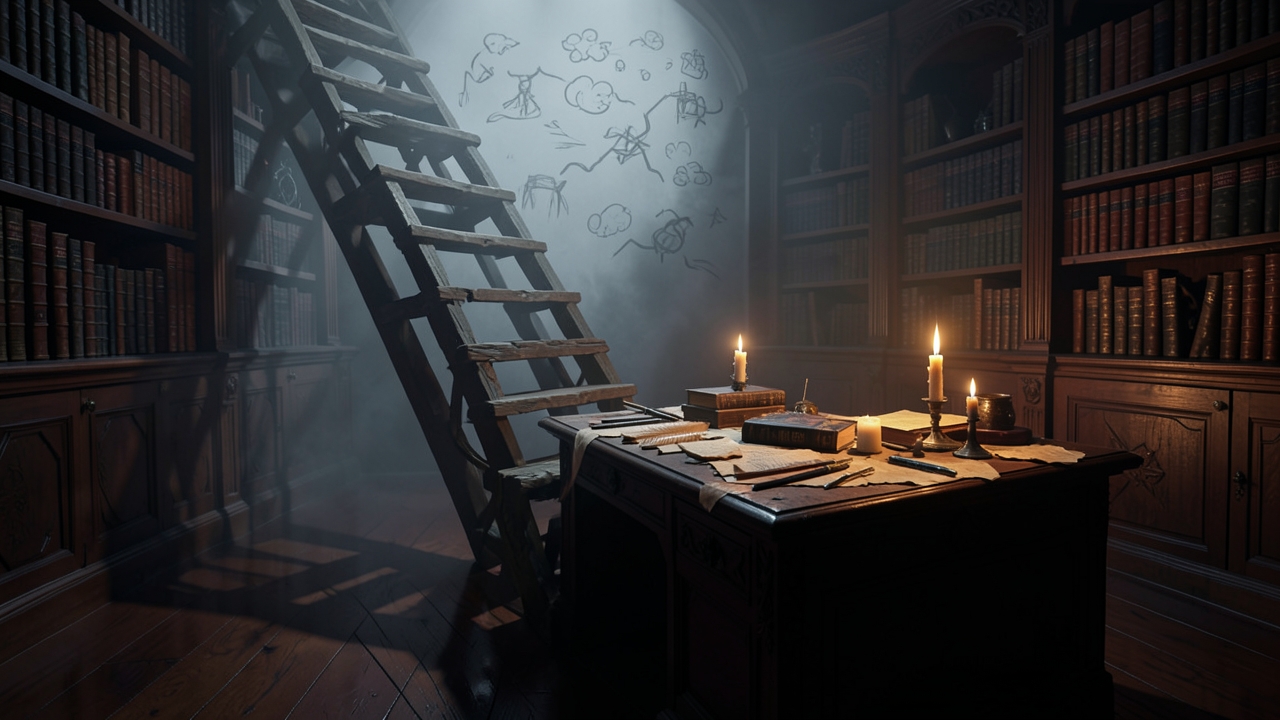
Have you ever felt your words drift into the hollow echo of abstraction, losing the gritty touch of reality? Or perhaps they cling too tightly to the concrete, shrouding deeper meaning in a veil of literalness? The ladder of abstraction writing offers a path to ascend from mere description to emotional resonance, a tool as vital in gothic prose as a flickering candle in a cursed manor.
In the craft of storytelling, this concept guides writers from specific, sensory details to universal themes, enhancing both clarity and impact. As Edgar Allan Poe mastered the shadows between reality and nightmare, so too can we learn to balance these realms. Let us embark on this journey, where each rung of the ladder reveals new depths of meaning.
What is the Ladder of Abstraction in Writing?
The ladder of abstraction is a framework that illustrates how language moves from concrete, tangible elements to abstract, conceptual ideas. At the base, concrete language grounds the reader in sensory experience. As we ascend, abstract language evokes emotions, themes, and thoughts. This balance prevents prose from becoming either vague or overly literal.
For example, in gothic fiction, a concrete detail like a “cracked window pane” can symbolize the fractured psyche of a character. However, without abstraction, it remains mere description. By climbing the ladder, that window becomes a metaphor for isolation or decay, deepening the narrative’s emotional resonance.
The Concrete Base: Grounding Your Prose
Concrete language appeals to the senses—sight, sound, touch, taste, and smell. It anchors the reader in the moment, creating vivid imagery. In Shirley Jackson’s The Haunting of Hill House, the “cold walls” and “draughty hallways” are concrete details that build immediate unease. This foundation is essential for immersion.
However, reliance on concrete details alone can leave the prose feeling flat. For instance, describing a “dark room” lacks the abstract weight of fear or mystery. Therefore, writers must use concrete elements as rungs on the ladder, not the entire climb.
Ascending to the Abstract: Elevating Meaning
Abstract language delves into concepts like love, death, fear, or existential dread. It transcends the physical to touch the universal. In Edgar Allan Poe’s “The Raven,” the concrete raven perching on a bust evolves into an abstract symbol of eternal loss. The bird’s “Nevermore” echoes not just a sound, but the abyss of grief.
This ascent allows writers to convey complex emotions succinctly. For example, instead of detailing every shadow in a haunted house, an abstract phrase like “the weight of forgotten sins” can evoke a deeper psychological horror. Thus, the ladder enables a seamless flow between tangible and intangible.
Why Balance is Crucial: Clarity and Emotional Resonance
Balancing concrete and abstract language ensures prose remains clear yet profound. Too much abstraction can confuse readers, leaving them adrift in vague ideas. Conversely, excessive concreteness may bore them with mundane details. The ladder of abstraction writing strikes this equilibrium, much like the chiaroscuro in gothic art—where light and shadow define form.
In literary fiction, this balance enhances emotional resonance. Consider Daphne du Maurier’s Rebecca: the concrete description of Manderley’s gardens contrasts with the abstract menace of Mrs. Danvers. This interplay creates a haunting atmosphere that lingers in the mind. Therefore, mastering this ladder is key to crafting prose that haunts and clarifies.
Examples from Gothic Masters: The Ladder in Action
Gothic literature thrives on this balance, using abstraction to amplify horror and beauty. Here, we explore how masters employed the ladder to elevate their tales.
Edgar Allan Poe: From the Raven to the Abyss
Poe’s work is a masterclass in ascending the ladder. In “The Fall of the House of Usher,” the concrete decay of the mansion—”bleak walls,” “vacant eye-like windows”—serves as a rung for the abstract decay of the Usher bloodline. The house becomes a metaphor for mental dissolution, blending literal and figurative seamlessly.
For example, the “fissure” in the wall is concrete, but it abstractly represents the fracture in Roderick Usher’s sanity. This technique allows Poe to convey psychological depth without sacrificing clarity. In addition, his use of rhythmic language adds another layer of abstraction, enhancing the emotional cadence.
Shirley Jackson: The Haunting of Hill House
Jackson’s prose often starts with concrete sensations to ground the supernatural. The “cold spot” in Hill House is a physical detail that abstractly signifies the presence of past tragedies. Through this ladder, she creates ambiguity that unsettles the reader, as reality and perception blur.
For instance, Eleanor’s concrete actions, like touching a wall, ascend to abstract themes of belonging and madness. Jackson’s balance ensures the horror feels intimate and universal, demonstrating the power of the ladder of abstraction writing in gothic fiction.
Other Gothic Voices: du Maurier and Lovecraft
In Dracula, Bram Stoker uses concrete details like the castle’s architecture to abstractly represent colonial fears. H.P. Lovecraft, in “The Call of Cthulhu,” begins with concrete artifacts but ascends to abstract cosmic horror, where concepts like “ineffable” and “indescribable” evoke terror beyond comprehension.
These authors show that abstraction isn’t evasion but elevation. By referencing specific works, we see how the ladder enhances descriptive clarity while deepening emotional layers. For more on gothic descriptive techniques, explore our guide to gothic imagery.
Techniques to Climb the Ladder of Abstraction Writing
To harness this tool, writers can follow practical steps, ensuring their prose ascends gracefully.
Start Concrete, Then Abstract
Begin with a concrete image or detail to anchor the reader. Then, gradually introduce abstract elements to layer meaning. For example, instead of saying “she felt sad,” write “the rain-soaked street mirrored her hollow ache.” This moves from tangible to emotional, creating resonance.
In gothic contexts, a concrete shadow can abstractly symbolize guilt or secrets. This method avoids telling and instead shows, which is crucial for immersive storytelling. Therefore, practice by revising descriptions to include abstract follow-ups.
Use Sensory Details as Rungs
Sensory details provide the concrete rungs for your ladder. Engage sight, sound, and texture to build a vivid foundation. For instance, in Lovecraft’s work, the “slimy” texture of alien creatures grounds the abstract horror of the unknown. This tactile quality makes abstraction more palpable.
However, ensure details serve a purpose; otherwise, they clutter the prose. Each rung should propel the narrative forward. By doing so, your writing maintains clarity while reaching for thematic depth. For further reading on sensory writing, see our article on sensory techniques.
Embrace Ambiguity with Precision
Abstract language thrives on ambiguity, but precision is key to avoiding confusion. Use specific abstract terms that align with the concrete context. For example, in Jackson’s work, “the house was watching” is abstract yet precise in its implication of surveillance. This balance keeps readers engaged without alienating them.
Additionally, transition words like “therefore” or “however” can guide the reader between rungs. Active voice, such as “The shadow whispered” instead of “A whisper was heard by the shadow,” enhances immediacy. Thus, practice crafting sentences that flow naturally up and down the ladder.
A Final Reflection: The Echoes of Abstraction
In the end, the ladder of abstraction writing is not a rigid tool but a poetic dance between worlds. Like Poe’s raven or Jackson’s haunted house, it invites us to explore the shadows where concrete meets abstract. This balance is what makes prose hauntingly clear, evoking emotions that linger long after the page is turned.
So, as you craft your own tales, ask: where on the ladder do your words reside? Are they grounded in the earth, or do they reach for the stars? By mastering this ascent, you can weave prose that is both a mirror of reality and a window into the abyss. Let your writing be a ladder that others dare to climb.
For more on the craft of storytelling, visit our exploration of gothic narrative, or delve into external resources like the