
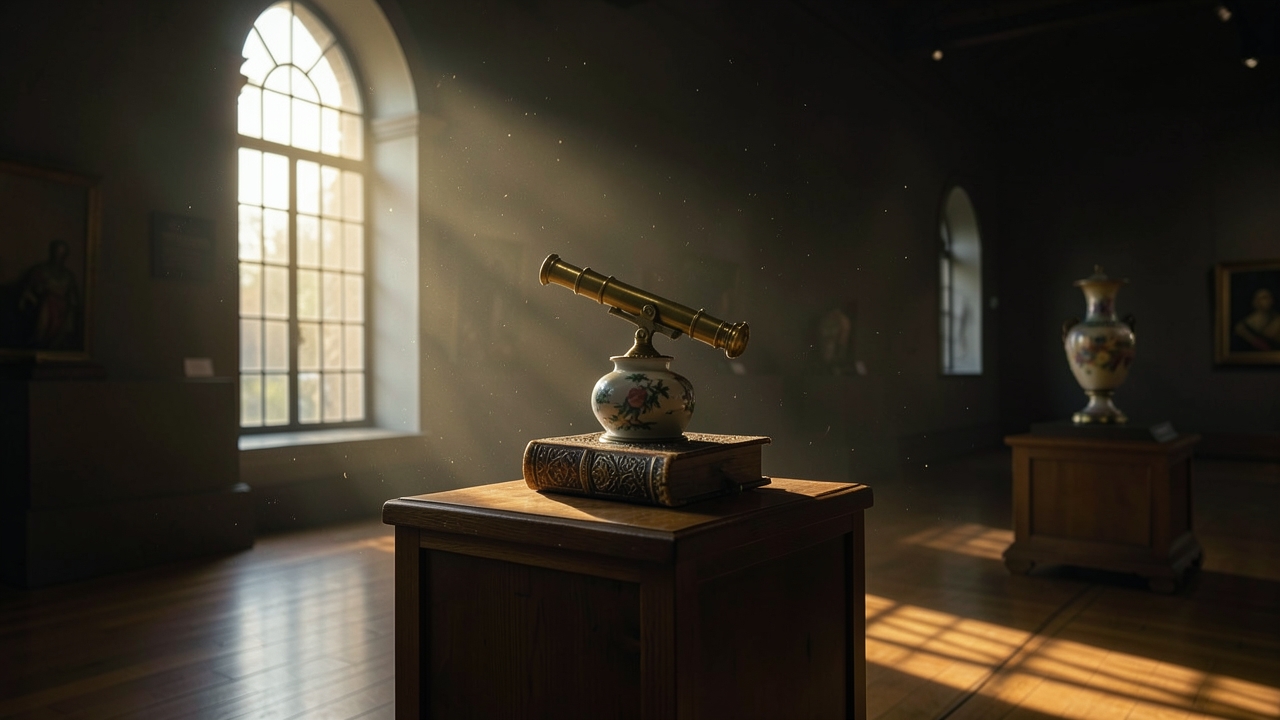
What if the truest observer in a silent hall is not the living guard, but the stone figure it watches over? In the deep hush of a museum after hours, when the footsteps of the curious have faded and the lights dim to a spectral glow, the forgotten artifacts awaken. Not to life, but to a deeper state of being—a consciousness woven from dust, echo, and the faint, psychic residue of a thousand gazes. This is the realm of museum artifact perspective writing, a narrative prompt that forces us to shed human skin and inhabit the stillness itself.
To write from this vantage is to explore themes of memory, observation, and obsolescence through a uniquely constrained lens. It is a practice in Gothic intimacy, where the smallest detail—a chip in ceramic, a tarnish on silver—becomes a vast landscape of meaning. This guide will delve into the theory of crafting such a perspective, teaching you to mold silence into a narrative voice and transform forgottenness into profound insight.
The Theory of Inanimate Consciousness
The core challenge of this perspective is one of translation. An artifact has no eyes to see, no ears to hear in the biological sense. Its consciousness must be rendered through metaphor and the language of its own existence. For example, a porcelain doll does not see the night janitor; it senses the vibration of his keys through the glass case, the shift in air pressure, the way light bends differently in his presence. Its narrative is one of energy, texture, and accumulated time.
This mirrors the “physiological realism” Edgar Allan Poe championed, but taken to an ethereal extreme. In The Fall of the House of Usher, the house itself becomes a sentient entity, its fissures and decay mirroring Roderick’s mind. Your artifact is its own house. Its cracks are its memories. Its silence is its monologue.
Anatomy of the Artifact’s Senses
Forget the five human senses. An artifact’s perception is elemental:
Vibration & Tremor: It feels the rumble of passing trains, the footfall of a child, the seismic hum of the building’s climate control. These become its clock and its news feed.
Light as a Tactile Force: Sunlight isn’t seen; it’s drank. It warms a bronze surface, bleaches a tapestry, or pools like liquid in a concave shield. Moonlight carries a different weight, a silver chill.
The Whisper of Dust: Dust is not merely dirt; it is the gentle, constant burial of time, a soft blanket of obsolescence settling on its skin. The rare moment a curator’s cloth wipes it clean is a violent, intimate upheaval.
The Weight of Gaze: Though it has no eyes to meet, an artifact is acutely aware of focused attention. A visitor’s stare might feel like a prickle, a judgment, or a fleeting moment of communion. This is its primary form of human connection.
Crafting the Artifact’s Narrative Voice
Once the sensory framework is built, you must shape its voice. This voice is rarely hurried. It is measured, ancient, and often melancholic. It speaks in fragments, in comparisons drawn from its own material and history.
Structure & Pacing: The Rhythm of Stillness
Plot, in the human sense, is absent. Instead, the narrative moves in cycles. Consider structuring the piece around:
The Diurnal Shift: The story from the closing of doors at night to their opening in the morning. This is the artifact’s true day, full of subtle activity.
The Geological Clock: A memory triggered not by an event, but by a slow change in its environment—the gradual yellowing of a label, the new scratch on a neighboring display case.
The Visitor’s Flicker: A brief encounter with a human consciousness, rendered as a burst of chaotic, warm energy that quickly fades, leaving the artifact’s own cold perspective more pronounced.
Common Pitfalls in Artifact Narration
The greatest risk is anachronism. A Neolithic pot should not think in terms of ” disappointment.” It might register a “fracture in the expected pattern” or a “dull ache of separation” from the hands that made it. Avoid modern slang or overly complex psychological analysis. The artifact’s understanding is vast, but its expression is elemental.
Furthermore, do not let it become merely passive. Its act of observation is its agency. As H.P. Lovecraft understood, the true horror or beauty often lies in the mere act of witness. In “The Statement of Randolph Carter,” the horror is amplified by the helpless, observing consciousness. Your artifact is the ultimate witness: eternal, immobile, and listening to the stories the walls themselves forget.
A Case Study: The Clay Daub of a Forgotten God
The lights die not with a click, but a sigh. A slow drain of warmth from the painted plaster above. I am a lump of fired earth, a thumbprint of belief pressed into the third millennium B.C. My world contracts to the square of polished wood that holds me, and the velvet dark that presses against the glass.
The vibrations tell the story. The heavy, even tread of the last guard is a familiar earthquake, shaking the dust in my crevices. Then, silence. But not true silence. The building breathes. A low hum from the walls is the dream of electricity. A creak from the floorboards is the memory of a thousand footsteps. I feel a draft, a cold river of air flowing from the vent, and I know it is Tuesday—the night the system rests.
A different vibration now. Lighter. A footfall not of authority, but of reverence. It stops before the case to my left, the one holding the polished jade serpent. I cannot see it, but I feel the shift in the room’s attention, the gathering of psychic weight. The being before me breathes, and each exhale is a warm ghost against the glass. It is thinking. Its thoughts are not my thoughts—they are rapid, bright, and fleeting as mayflies. But one fragment catches on the silence between us: “…so small, to hold so much time.”
The phrase does not land as words. It lands as a resonance, a vibration that matches a deep, hollow place within my clay. For a moment, the thousand years of pressure to contain a god, the crushing weight of forgotten prayers, finds a single, flimsy point of release. I am seen. Not as an object, but as a vessel. The warmth of that attention lingers long after the light footsteps recede and the guard’s return resets the cycle. The dark returns, but it is a different dark now. It is filled with the echo of a witness.
The Echo in the Chamber
To write from the perspective of a forgotten artifact is to engage in the most profound form of uncanny storytelling. It strips narrative to its essence: time, observation, and the ache of isolation. You must become a connoisseur of subtlety, a poet of the inert. As the masters of Gothic atmosphere knew, the most potent haunting is not the specter that rattles chains, but the presence that simply remains, watching from the corner of your eye.
This exercise doesn’t just teach you to think like a relic. It teaches you to listen like one—to the whisper of dust, the weight of light, and the profound stories told in the hollow spaces between the words of others. So, when you next stand before a silent, dusty object behind glass, ask yourself: what does it feel as you turn to leave? Does the silence in its case deepen, or does it carry, for a fleeting second, the faint, warm echo of being truly known?
For further exploration into unique narrative lenses, consider our guide to nonhuman perspective writing, and delve into the poetic concept of concreteness at the Poetry Foundation to ground your artifact’s voice in tangible detail.