
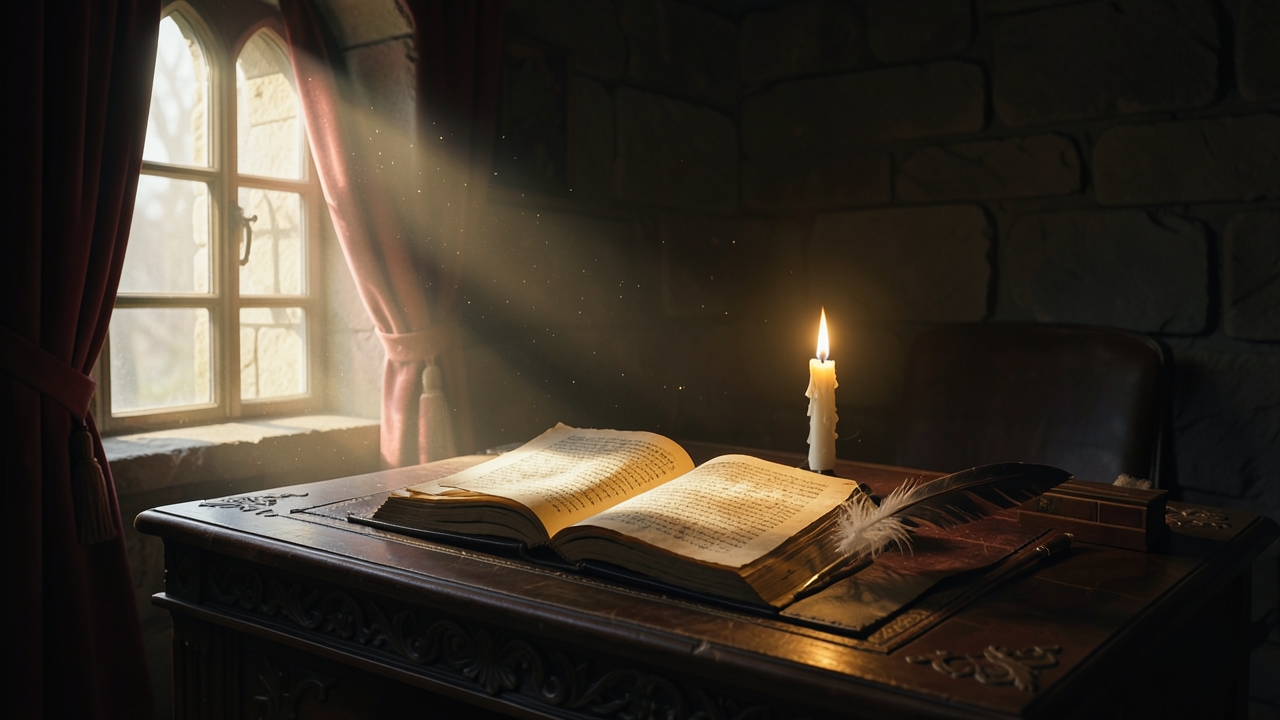
What if every scene you wrote ended mid-breath? Suppose the last line of every chapter hung in the air like smoke from a snuffed candle, refusing to settle. That is the beating heart of the unanswered question writing prompt — a discipline that trains suspense from the marrow outward, one unanswered beat at a time.
Most writers chase tension in the middle of a scene. Fewer engineers it at the edge. Yet the edge is where a reader decides to turn the page or close the book. In 2026, with attention scattered across a hundred glowing screens, that decision happens faster than ever. Therefore, this week’s prompt is a kind of ascetic practice: write scenes that refuse to resolve.
Why the Unanswered Question Writing Prompt Works
The human mind abhors a vacuum. When a narrative leaves a loop open, the brain tugs at it compulsively. Psychologists call this the Zeigarnik effect: unfinished tasks occupy memory more stubbornly than completed ones. Fiction exploits the same wound.
The Open Loop and the Reader’s Pulse
An unanswered question creates what I call an open loop. The reader carries it like a stone in the pocket. Consequently, they keep reading — not because you begged them to, but because the loop aches to close.
Consider how gothic storytelling techniques have always weaponized the unknown. The castle door that will not open. The letter that arrives without a signature. Silence does more work than exposition ever could.
The Anatomy of a Scene-Closing Question
Not every question qualifies. A weak question — “What happens next?” — is generic. A strong one is specific, personal, and slightly dangerous. It implicates a character the reader trusts.
Therefore, a scene-closing question should meet three tests. First, it must arise naturally from the scene’s action. Second, it must carry emotional weight, not merely plot weight. Third, it must be answerable — but not yet.
Crafting the Question: Techniques from the Masters
The craft of the unanswered question is ancient. Yet each master sharpens it differently. Let us walk among the tombs and study their instruments.
Edgar Allan Poe and the Single Effect
Poe argued that every element of a tale should conspire toward one preconceived effect. In “The Tell-Tale Heart,” the narrator’s final cry — “Villains! I admit the deed!” — resolves the plot but deepens the mystery of the mind. The reader is left asking not what happened, but whether sanity ever resided there at all.
The lesson: let the closing question target the interior, not merely the exterior. Ask who the character truly is, not only what they will do.
Daphne du Maurier and the Quiet Menace
Du Maurier rarely raises her voice. In Rebecca, the second Mrs. de Winter never learns the full truth of what happened at Manderley before the fire. The novel ends with a plume of smoke on the horizon and a marriage drifting toward ruin.
In addition, notice how she withholds. The unanswered question in du Maurier is almost always domestic — a door, a room, a name never spoken. Therefore, her dread feels wearable, like a coat that fits too closely.
Shirley Jackson, Tana French, and the Unreliable Confidant
Shirley Jackson’s We Have Always Lived in the Castle closes with Merricat’s savage contentment. We never know precisely what Constance knows. The silence between the sisters becomes the novel’s true narrator.
Tana French performs a similar feat in the Dublin Murder Squad series. Each book resolves a case while dissolving the certainty of the detective. Consequently, the reader finishes one novel already poisoned with doubt about the next.
Meanwhile, the deeper lesson here concerns writing unreliable narrators: the most durable questions are those that make us distrust the voice telling the story.
Lovecraft, Borges, and the Cosmic Unknown
Lovecraft understood that terror lies in scale. His narrators often end mid-sentence, shattered by a geometry the reader can only imagine. The question left behind is not “what is that thing?” but rather “was it ever meant for human eyes?”
Jorge Luis Borges offers the cerebral cousin. In “The Garden of Forking Paths,” the final revelation rearranges everything that came before. Yet it opens a corridor the reader must walk alone. For example, the map does not explain itself; it merely multiplies.
How to Run the Prompt: A Seven-Day Framework
Now to the practice itself. Treat the unanswered question writing prompt as a weekly exercise, not a masterpiece factory. Speed and honesty matter more than polish.
Day One: Harvest Your Questions
Begin with a notebook. Write twenty questions your story has not answered. Keep them sharp. “Will she open the letter?” beats “what will happen?” every time.
Days Two Through Six: Scene by Scene
Write one scene each day. Do not outline the ending. Instead, draft until a question surfaces unbidden. Then cut immediately after it. Therefore, you learn to trust the cut as much as the sentence.
Meanwhile, resist the urge to explain. Explanation is the enemy of the hook. If a scene ends with a character realizing something, do not tell us what. Let the realization glow behind their eyes like a lamp behind frosted glass.
Day Seven: The Excision Pass
Return to your pages with a knife. Remove every line that resolves a question early. Read the final line of each scene aloud. If it lands with a thud rather than a shiver, rewrite it.
Common Pitfalls to Avoid
The prompt has teeth, and it can bite you. Beware three recurring wounds.
The Cheap Cliffhanger
A character mid-fall is not a question; it is a stunt. Suspense requires emotional investment before the drop. If the reader does not care who falls, the fall is merely weather.
The Unanswerable Void
Some questions are so vague they evaporate. “Is everything a lie?” leaves nowhere to land. In contrast, “Did her brother write the letter, or did she?” gives the reader a hinge to grip.
Accumulation Without Payoff
Questions must eventually answer one another, like stones laid across a stream. If you stack ten open loops and close none, the reader drowns. Consequently, resolve at least one question every few scenes while opening two new ones.
For a broader meditation on the architecture of dread, read building suspense in fiction — it pairs naturally with this exercise.
A Case Study: The Lodger’s Lantern
Below, an original tale built strictly to the prompt’s law. Every scene closes on a question no honest reader could ignore.
The house at the end of Fenwick Lane had been empty for eleven years, and yet a lamp burned in the upper window every night at precisely half past nine. Elowen first noticed it on the evening she came to sign the papers. She asked the solicitor about the light, and the solicitor smiled without answering her. When she looked again, the window was black — and her own name was already inked on the deed. Had she signed it, or had someone signed for her?
Inside, the dust lay like grey snow, except for a single path of footprints leading from the door to the stairs. Elowen followed them with her lantern held low, counting each print as though counting heartbeats. At the top landing, the footprints stopped at a door that stood ajar, and from within came the soft rustle of a page being turned. She pressed her palm to the wood and felt it warm, almost feverish — as though the room beyond were breathing. Who was reading, in a house no one had entered since before her grandmother died?
The room held a desk, a chair, and a ledger bound in cracked leather. Elowen opened it. Every page was filled with her handwriting, though she had never touched the book. The last entry was dated tomorrow, and it described, in patient detail, the exact hour she would leave Fenwick Lane and never return. Beneath the entry waited a single blank line, as if the ledger were waiting for her to write it herself. If the book already knew her future, what remained of her choice?
A floorboard groaned behind her. Elowen turned, raising the lantern, and found no one — only the door swinging shut of its own accord, and a shadow sliding beneath it like water. She called out, and her voice returned to her altered, as though someone had rehearsed it first. When the door opened again, the hallway was empty, and on the threshold lay a fresh sheet of paper bearing one line in her own hand: Do not read the next page. What would she find there — and would she obey?
The Echo at the End
We began with a question, and so we end with one. Suspense is not the art of hiding information; it is the art of placing it where the reader can almost touch it.
Therefore, take up this week’s unanswered question writing prompt and let your scenes fall silent one heartbeat too soon. Cut the explanation. Trust the shiver. Leave the lamp burning in the upper window.
And when the last line of your draft finally settles into stillness — will it whisper, or will it ask?
For further study of hook mechanics and narrative tension, consult the craft essays at Literary Hub, and the rhetorical analyses at the Poetry Foundation.