
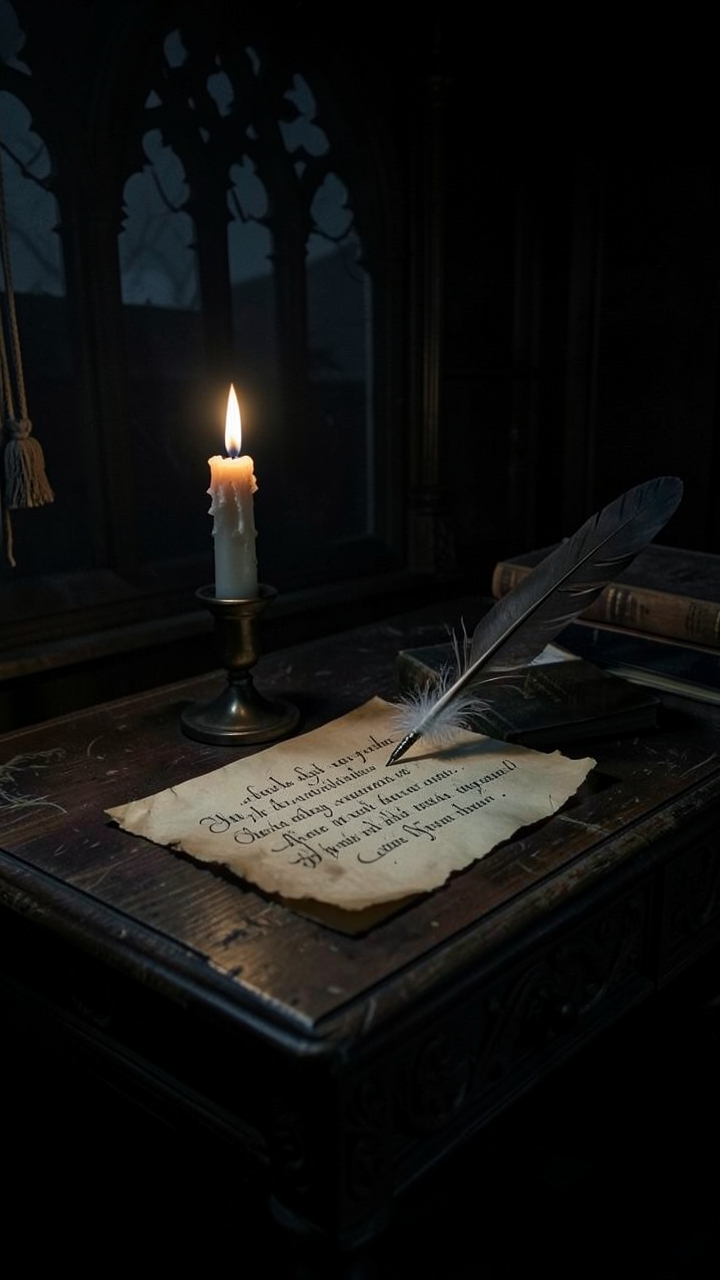
What is a writing prompt but a single, flickering candle in the vast, dark library of the mind? Does it not call to you from the shelf, whispering of untold stories? Today, we explore the transformative power of gothic writing prompts—those evocative fragments designed not just to spark an idea, but to cultivate a particular and haunting atmosphere.
The Anatomy of an Effective Gothic Prompt
A potent prompt is more than a scenario; it is a sensory trigger and an emotional key. It should evoke a setting, suggest a conflict, and hint at a deep-seated fear or desire. Consider the classic elements: a confined space, an unexplained sound, a decaying relic, a secret. These are the bones. The flesh, however, is the specific, unsettling detail.
For instance, a prompt like “A portrait in an attic” is merely a setting. But, “You inherit a portrait from a forgotten relative; its eyes seem to follow you, and the signature on the back is in your own handwriting”—that is a keyhole into a narrative. The difference lies in the immediate, personal unease. As Edgar Allan Poe mastered in “The Fall of the House of Usher,” atmosphere is everything. The physical decay of the Usher mansion mirrors the family’s psychological disintegration. Your prompt must plant a similar seed of decay or fracture from its very first clause.
Crafting the Atmosphere: More Than Just Dark and Stormy
Atmosphere is the true protagonist of gothic fiction. It is an active force, not a passive backdrop. To answer a prompt effectively, you must first immerse yourself in its mood. Ask: What is the quality of light here? Is it a bruised twilight or a sterile, electric glare? What is the dominant sound—the drip of water, the groan of old wood, or a profound, oppressive silence?
Daphne du Maurier excelled at this. In Rebecca, Manderley is not just a house; it is a character suffused with the lingering presence of its former mistress. When your prompt says “a secluded manor,” you must ask what ghost it truly harbors. Is it literal, or is it a memory that stains the wallpaper? Begin by writing a single paragraph describing only the atmosphere, before any character enters or any action occurs. This exercise trains you to feel the scene.
The Psychology of the Prompt: What Lies Beneath
The most haunting stories are not about external monsters, but internal fractures. A great prompt should hint at a psychological vulnerability. “A locked room” is a physical problem. “A locked room you have no memory of locking, from the inside” is a crisis of the self. This shifts the genre from mere mystery to existential horror, the domain of writers like Shirley Jackson.
In “The Haunting of Hill House,” Jackson brilliantly uses the house to amplify Eleanor Vance’s fragile psyche. The real terror is her dissolving mind. When faced with a prompt like “You discover your doppelgänger,” consider making it less about supernatural doubles and more about a profound crisis of identity or repressed guilt. What part of yourself does this double represent? The prompt is an invitation to explore the shadow self, that “other” we keep locked within.
From Prompt to Narrative: The Practical Alchemy
Having contemplated the atmosphere and psychology, it is time for alchemy—transmuting leaden words into golden unease.
- Limit Your Elements: Choose one potent image from the prompt. Don’t try to include every gothic trope. A single, recurring shadow can be more terrifying than a parade of ghosts.
- Employ the Unreliable Lens: Filter the prompt through a narrator who might not see reality clearly. This introduces ambiguity and heightens suspense. Is the shadow in the corner real, or a projection of their fear?
- Use the Prompt as a Springboard, Not a Cage: The prompt sets the first domino. Your task is to tip it and follow the chain of consequences. Let the story’s internal logic take over.
A master of this internal logic is H.P. Lovecraft. While his scope is cosmic, his technique of a narrator piecing together forbidden knowledge is perfectly scalable. Your narrator might be piecing together the truth of the “portrait in the attic,” discovering a truth that unravels their reality. The fear comes from understanding, not just not knowing.
A Case Study: The Last Scribe of Blackwood College
The weekly prompt was simple: “A library that closes its books… forever.” Here is the seed that grew from it.
The final bell did not chime. It was more a sigh, a release of breath held for centuries. I, the last scribe, felt it in the marrow of my bones as the great oak doors of Blackwood College’s library swung inward—not with a welcome, but with a final, groaning exhale. Dust motes danced in the slivers of dying afternoon light, each a tiny ghost. My task, decreed by the Head Archivist in a note left on his empty desk, was simple and monumental: to enter the Restricted Annex and catalog the one volume left behind.
The air inside was colder, thick with the scent of brittle paper and a faint, metallic tang, like old coins or dried blood. The shelves rose into a gloom so profound the ceiling was a myth. My lantern light slid over spines with titles in languages I did not know, and some that seemed to shift when viewed peripherally. The note had named the volume: The Silent Lexicon of Forgotten Sounds. I found it not on a shelf, but lying open on a lone reading table, as if awaiting me. Its pages were not paper, but something like vellum, and utterly blank.
A tremor, part fear, part revelation, went through me. I touched a page. It was not blank. A texture, like blind writing, marred its surface. I fetched the university’s oldest magnifying glass from my satchel. Under its lens, the page exploded into a world of microscopic script, cramped and frantic. And as I leaned closer, I began to hear it. A soft, constant murmur, like the whisper of a million turning pages heard from a great distance. The book was not a catalog of sounds. It was their tomb. And by coming here, by seeking to catalog the final closure, I had become its new librarian, its eternal scribe. The library had not closed its books forever. It had merely changed its keeper.
Your Turn: Embrace the Prompt’s Shadow
A writing prompt is a door. It is your task to not merely open it, but to step through and describe what you find in the darkness beyond. It is an exercise in deliberate observation, in psychological excavation, and in the careful crafting of dread and beauty. It teaches you to control atmosphere and to find the human heart beating inside the gothic shell.
So, when your next weekly prompt arrives, do not simply ask, “What happens next?” Ask instead, “What does this place fear?” and “What secret does this character keep from themselves?” The answers will lead you into the very heart of storytelling. After all, is the truest horror not the unknown, but the moment of terrible, intimate recognition?
“The boundaries which divide Life from Death are at best shadowy and vague. Who shall say where the one ends, and where the other begins?” — Edgar Allan Poe, The Premature Burial