
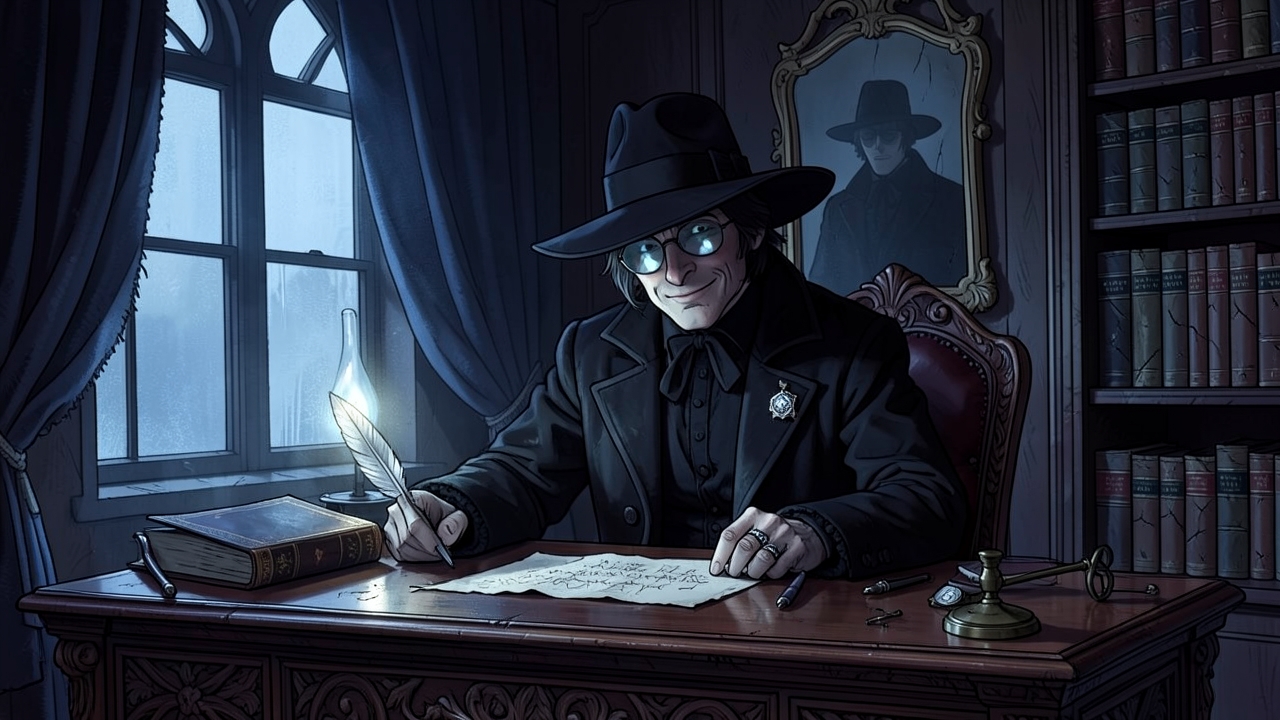
What if the voice confessing the tale is the very source of the terror? What if the shadow in the corner is not an intruder, but a projection from a mind unraveling? This is the domain of the unreliable gothic narrator, a device that moves beyond simple deception. It becomes the atmosphere itself, staining every word with the ink of subjective dread.
In 2026, we are fascinated by fractured perspectives. Yet this technique has deep, haunted roots. It thrives not on the shock of a twist, but on the slow, creeping corruption of the reader’s trust. Let us dissect this dark art, from the fevered cell to the modern mind, learning how to craft a confession that feels like a curse.
The Anatomy of a Corrupted Lens
An unreliable gothic narrator does not simply lie. Their perception is a prism, refracting reality through trauma, obsession, madness, or guilt. The horror emerges from the gap between their telling and the likely truth. We, the readers, become detectives of the soul, piecing together the real decay from the narrator’s corrupt account.
Poe’s Blueprint: The Narrator of Conscience
Edgar Allan Poe perfected the blueprint. In “The Tell-Tale Heart,” the narrator insists upon his sanity while detailing its complete collapse. His heightened senses—the tinnitus of guilt, the perceived evil in an old man’s eye—are the story’s true landscape. We do not fear the police at the end; we fear the narrator’s mind, which has already imprisoned him. The dread is entirely subjective, born from his corrupted narration.
As analyzed by the Poetry Foundation, Poe’s narrators often blur the line between victim and perpetrator. This duality is key. The narrator is haunted, yet they are also the haunting.
Techniques for Crafting the Veiled Truth
How, then, do we weave this veil? First, employ contradictory evidence. Let the narrator claim bravery while their actions reveal cowardice. Describe a loving glance that the context reveals as predatory. Second, use perceptual distortions. Let them hear whispers in silence, or see affection where there is only contempt. As Shirley Jackson did in We Have Always Lived in the Castle, the world bends to the narrator’s strange, childish logic.
Third, leverage omission and misdirection. The narrator fixates on a trivial detail—a stain on a carpet, a ticking clock—while avoiding the monumental truth. This creates a profound unease. For example, the narrator in Daphne du Maurier’s Rebecca, though not overtly mad, colors every memory with jealousy and insecurity, making Manderley a palace of her own insecurities. The true monster may be her own perspective.
From Confession to Corruption: The Modern Evolution
Contemporary gothic fiction has expanded this role. The unreliable narrator is no longer just a madman in an attic. They are an unreliable historian, an unreliable lover, an unreliable witness to their own life.
The Domestic Uncanny
Tana French excels at this. In The Likeness, detective Cassie Maddox investigates a murder that mirrors her own past undercover identity. Her narration blends professional insight with personal trauma. The line between her current case and her old, buried self blurs. The corruption here is subtle; it’s the slow seepage of a past self into the present, making the reader question what is observation and what is projection.
Meanwhile, Gillian Flynn’s Gone Girl weaponizes the unreliable gothic narrator on a societal scale. Amy’s diary is a masterwork of crafted, saccharine unreliability, a performance of the “cool girl” trope designed to corrupt the reader’s sympathies entirely. The dread comes from realizing we have been manipulated by a narrative as surely as the characters within it.
The Narrator as Atmosphere
In gothic horror, the narrator’s voice should feel like the house itself—creaky, full of forgotten corners, and with a foundation of secrets. Consider how Silvia Moreno-Garcia uses setting as an extension of the narrator’s inner state in Mexican Gothic. The decaying High Place is a reflection of the toxic, oppressive family history the protagonist is beginning to internalize. The narrator’s growing dread is indistinguishable from the mansion’s own aura.
This technique aligns perfectly with the concept of the “unreliable gothic narrator.” The environment doesn’t just scare them; it becomes an extension of their unreliable perception. A hallway is not just long; it is a throat that swallowed someone. A portrait’s eyes don’t just follow you; they accuse you.
A Case Study: The Curator of Silences
The dust in this archive does not settle. It accumulates, layer by layer, upon the spines of books that were never meant to be read. I am their curator. My predecessor called it a collection of forgotten histories. I know better. They are not forgotten. They are the things that actively choose to be remembered only in darkness.
Today, I found the journal of a girl named Elara. The ink is a faded brown, like dried blood. She writes of a constant companion, a “grey lady” who visits her window at dusk. She describes the lady’s touch as cold, but not unkind. “She promises to carry the weight,” Elara writes, “the weight of seeing things others will not.” The final entry is just a single line, repeated across three pages in a shakier hand: “She is not carrying it. She is it.”
I closed the journal. The archive felt colder. The silence was different—not empty, but full of held breath. I told myself it was the draft from the ill-fitting door. I always tell myself it is the draft. But as I placed the book back on the shelf, I could not help but feel I was not locking Elara’s story away. I was letting her grey lady out. And I could not recall, with any certainty, if the grey lady was ever something separate from the girl herself.
The curator’s note is simple: “Acquisition corrupts the archivist.” I wrote it myself, last year. I think.
The Echo in the Chamber
The unreliable gothic narrator forces us into an uncomfortable intimacy. We are trapped inside a crumbling mind, forced to breathe its stale air and see through its fractured lens. The terror is not a stranger in the dark, but the dawning realization that the voice in our head, the one narrating the world, might be the most haunted place of all.
Crafting the gothic atmosphere requires more than creaky floors and candlelight; it requires a voice that can taint them with its own decay. By mastering this technique, we do not just tell a scary story. We make the reader an accomplice to the unraveling. We make them question the very foundation of the tale.
So, the next time you sit to write in the dusk, ask yourself: whose voice are you really hearing? And is it guiding you to the truth, or is it, like all the best gothic voices, carefully leading you deeper into the beautiful, corrupting dark?
For a deeper dive into the foundations of this mood, explore our guide on writing in the gothic style, or see how modern masters reinvent psychological horror.
Also, consider Literary Hub’s survey of the unreliable narrator in literary history for further scholarly context.