
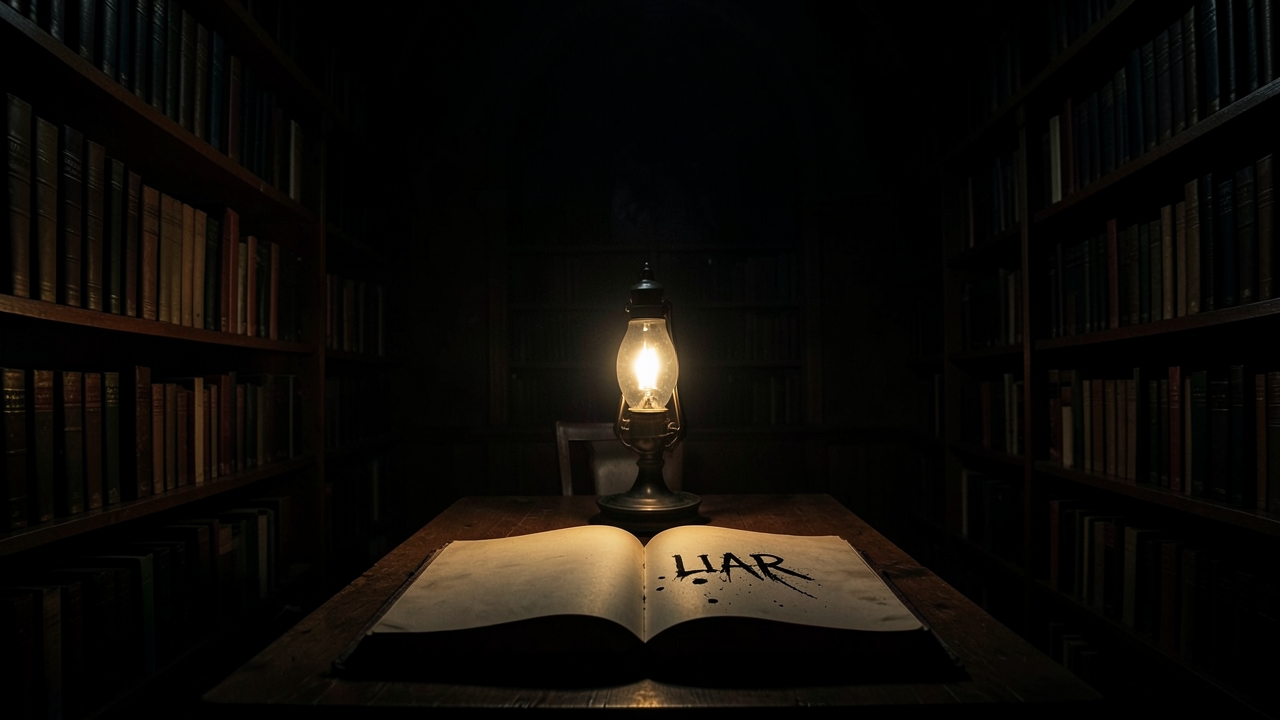
What is the first casualty of fear? Is it reason, or is it the very trust we place in the voice that whispers our own thoughts? In the shadows of psychological horror, the most terrifying specter is not a monster lurking in the closet, but the distortion within the familiar confines of our own mind. This is the domain of the unreliable narrator horror, a narrative puppeteer who pulls at the strings of perception, making the reader question not just the story, but their own judgment. To craft such a voice is to build a labyrinth of fractured truth, where every reflection lies.
The Anatomy of a Fractured Lens
An unreliable narrator in horror is not merely a character who lies to the reader. That is a simple deception. The true terror arises when the narrator lies to themselves, first and most fundamentally. Their perception is the story’s only window, and that window is warped, cracked, or painted black. This creates an intimate, claustrophobic horror. We are trapped inside their crumbling psyche, forced to navigate their distorted reality as if it were our own.
Consider the genius of Shirley Jackson in The Haunting of Hill House. Eleanor Vance narrates with a fragile, desperate poetry. We feel her longing for belonging, her raw nerves exposed to the house’s oppressive presence. Yet, from the very beginning, the line between the house’s influence and Eleanor’s pre-existing fractures blurs beyond repair. Is the cold spot a supernatural anomaly, or a manifestation of her profound isolation? Jackson never gives a clear answer. The horror stems from our dawning realization that Eleanor’s mind might be the primary haunted space.
The most effective unreliable narrator horror doesn’t ask, “What is real?” It whispers, “What if nothing you feel is trustworthy?”
Technique: The Internalized Haunting
To master this, anchor the external horror in your narrator’s internal flaw. Their fear, guilt, or obsession should act as a prism, bending every event. A floorboard creak becomes an accusatory footstep. A friend’s concern becomes veiled mockery. In Thomas Harris’s The Silence of the Lambs, while Clarice Starling is our heroic point of view, we are briefly subjected to the terrifyingly logical, yet utterly fractured, perception of Dr. Hannibal Lecter. His narration, when he controls it, is a masterclass in intellectualized distortion, reframing brutal acts as elegant necessities. The lesson here is specific: tie the unreliability to a distinct, compelling trait. For Jackson, it’s a desperate need for love. For Harris, it’s predatory intellect. For your narrator, it might be overwhelming grief, a paralyzing guilt, or a fanatical devotion.
The Layered Lie: A Structure of Deceit
The most potent unreliable narrator horror often employs a structure I term the “layered lie.” This is not a single untruth, but a cascade of deceptions, each built upon the last, designed to collapse all at once. The layers typically function as follows:
- The Social Lie: The narrator presents a curated, “acceptable” version of themselves to the world within the story. They downplay their fear, feign stability, or hide key past events from other characters.
- The Self-Deceptive Lie: This is the core layer. The narrator convinces themselves of a false narrative to protect their ego or sanity. They may reframe trauma as deserved punishment, or recast a monstrous act as a necessary sacrifice. They are the first and most believing audience of their own fiction.
- The Reader Deception: The narrative is constructed to align the reader with the narrator’s self-deception. We are given their skewed evidence, their emotionally charged interpretations, and their selective memories as the sole basis for the story. We become complicit in the lie.
The collapse of these layers is where the true horror detonates. The moment the reader sees the gap between the social lie and the truth, or recognizes the self-deception for what it is, the ground vanishes. This technique is wielded with devastating effect in modern works like Gone Girl by Gillian Flynn. Without spoiling its intricate twists, Flynn masterfully constructs and then demolishes layers of self-narrative, forcing the reader to reassess everything they believed about the protagonists.
Building Your Labyrinth of Lies
How do you construct this? Begin at the end. Know the objective truth of your story—the horror that truly happened. Then, work backward, crafting a persona for your narrator that would have every reason to obscure that truth.
- Plant Seeds of Doubt Early: Drop subtle, easily dismissed contradictions. A detail that doesn’t quite fit. A memory that shifts slightly between chapters. For example, the narrator might describe a victim’s eyes as blue in one paragraph and green in another, a flaw they rationalize as “the shock of it all.”
- Use Unreliable Senses: Describe the world through their biased perception. The house sighs in disapproval. A shadow lunges rather than moves. Let the environment be an extension of their fractured mind.
- Exploit the Confessional Tone: Horror narrators often address the reader directly, creating a false intimacy. This is the perfect vehicle for the self-deceptive lie. “You understand, don’t you? I had no choice.” This plea for validation draws the reader deeper into their distorted logic.
The Echo Chamber: Amplifying Isolation
The power of the unreliable narrator is magnified in isolation. Place your character in a setting that is both physically and psychologically isolating: a remote mansion, a failing marriage, a descent into illness. In Angela Carter’s The Bloody Chamber, the young bride is isolated by geography, age, and the monstrous secrecy of her husband. Her perception, steeped in gothic terror and sexual awakening, becomes the only reality we know. The isolation ensures there are no external voices to challenge her narrative, leaving the reader stranded with her.
This technique also works in urban settings. Haruki Murakami’s protagonists, while not always in horror, often experience a profound alienation that makes their perceptions feel dreamlike and suspect. The lesson is to cut off your narrator’s—and thus the reader’s—access to alternative perspectives. Make the unreliable voice the only voice in the room.
The Perils of Over-Revelation
A crucial craft element is pacing the revelation. The narrator’s reliability should fray slowly, not shatter in the first chapter. Allow the reader to trust them, to empathize with their plight. Let the unsettling details accumulate like dust in a forgotten room. By the time the central lie is exposed, the reader should feel implicated, having invested in the false reality. This mimics the real psychological experience of realizing someone close to you has been deceiving you—the horror is in the betrayed trust.
Silvia Moreno-Garcia, in Mexican Gothic, uses the growing illness of the protagonist, Noemí, to blur the lines between infection, manipulation, and genuine supernatural horror. The reader, alongside Noemí, struggles to discern what is a symptom of the house’s influence and what is her own mind unraveling. This ambiguity is the lifeblood of the genre.
The Final Unraveling: A Horror That Lingers
The beauty of the unreliable narrator horror is that its terror doesn’t end when the book is closed. It lingers in the quiet corners of the reader’s own thoughts. It plants a seed of doubt about the stories we tell ourselves. We all craft narratives to make sense of our lives, to protect our egos. This genre holds up a funhouse mirror to that universal human tendency and asks: what if your personal story is a carefully constructed lie?
The crafted unreliable narrator is therefore more than a plot device. They are a thematic engine. They embody the story’s central question about truth, memory, and identity. Their fractured perspective is the horror, long before any ghost appears or knife is drawn. To build one is to play a dangerous game with your reader’s mind, to invite them into a shared delusion, and to leave them, finally, alone with the unsettling echo of a voice that was never fully trustworthy.
As you craft your own tales from the shadowlands of the mind, consider this: in the grand, silent theater of the psyche, which actor is more terrifying—the monster on the stage, or the narrator in your ear, assuring you the stage is empty?