
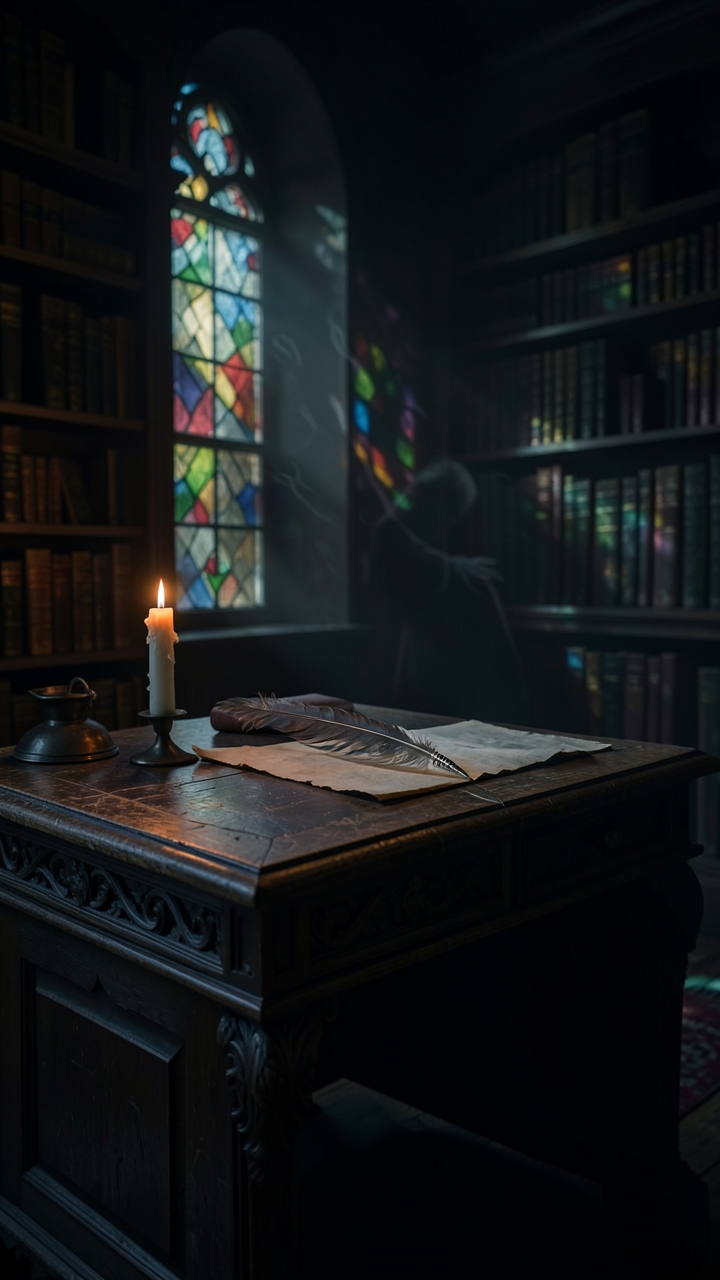
Have you ever closed a book, only to find its chilling whisper lingering in the silence of your own thoughts? The most potent stories do not simply end; they unravel a veil between the known and the unknowable, embedding themselves in the psyche. This is the essence of the uncanny narrative—a crafted reality that feels at once familiar and fundamentally wrong. To master this is to master the art of psychological haunting.
The Anatomy of Dread: Deconstructing the Uncanny
The uncanny, as Freud famously explored, is not the purely alien. It is the familiar made strange, the domestic twisted into something menacing. Therefore, effective gothic storytelling hinges on this unsettling alchemy. It is not about jump scares or gore, but about a slow, creeping distortion of the reader’s own sense of safety.
Consider Shirley Jackson’s The Haunting of Hill House. The terror is not merely the house, but the fragile psyche of Eleanor Vance. Jackson uses repetitive, rhythmic prose and sensory details—the chilling cold spots, the echoing knocks—to blur the line between external threat and internal decay. The house becomes an extension of Eleanor’s mind, a perfect, terrifying symbiosis. Your goal is to create a similar fusion, where setting and character are so intertwined that the narrative itself feels like a fever dream.
Atmosphere as Character: The Breathing Setting
A castle is not merely a castle; it is a repository of secrets. A fog is not just weather; it is a veil. Every element of your setting must participate in the mood. Daphne du Maurier, in Rebecca, never lets Manderley fade into the background. The house is a living character, a monument to memory and jealousy. The narrator, the second Mrs. de Winter, describes the gardens, the rooms, and the ever-present sea with such reverence and fear that the setting exerts a constant, oppressive pressure.
When crafting your narrative, ask: What does this place remember? What does it want? The scent of decaying roses, the groan of a specific floorboard, the way light dies at dusk—these are not decorations. They are the vocabulary of your uncanny world. They whisper subtext and build a palpable, unavoidable tension.
The Unreliable Lens: Distorted Perception
Nothing unsettles more than a protagonist we cannot fully trust. The uncanny narrative often employs a fractured perspective. In Gone Girl, Gillian Flynn weaponizes this brilliantly, giving us two unreliable accounts that dismantle the very idea of objective truth. The reader’s own judgment becomes unstable, mirroring the characters’ confusion and paranoia.
This technique is not new. Edgar Allan Poe, the master of the morbid mind, built entire tales on the collapse of sanity. In The Tell-Tale Heart, the narrator’s obsessive insistence on his own lucidity is the very proof of his madness. To use this, let your protagonist misinterpret, forget, or actively lie to themselves and the reader. Let their perceptions warp the story’s reality, making the reader question every shadow and every motive.
The Whisper of Detail: Specificity Breeds Fear
Vague horror is weak. The uncanny is born in hyper-specific, odd details. A love for a particular taxidermied bird. The precise color of a stain on a wedding dress. A phrase repeated under the breath. Jorge Luis Borges, in works like The Garden of Forking Paths, understood that intellectual and metaphysical dread can be built through labyrinthine, specific concepts.
Choose your details with ritualistic care. They must feel like clues to a mystery whose solution is itself a descent into madness. These specifics anchor the reader, making the subsequent distortions of logic and reality all the more jarring and believable. It is the contrast between the mundane detail and the grand, horrific implication that creates the shiver.
Common Pitfalls: The Broken Mirror
Many attempts at the uncanny fall into predictable traps. Over-reliance on clichéd Gothic tropes—the cackling ghost, the mustache-twirling villain—breaks the spell of realism necessary for true unease. Instead, seek the horror in the banal. The terror of Jackson’s The Lottery lies in its sunny, small-town normalcy.
Another pitfall is over-explanation. The uncanny thrives on ambiguity. As H.P. Lovecraft demonstrated in The Shadow over Innsmouth, the hinted-at horror, the half-seen shape in the murk, is often more potent than a full reveal. Leave room for the reader’s imagination to complete the picture, for their own mind is the most fertile ground for dread. Do not explain the curse; show its corrosive effect on the living.
A Case Study: The Echo in the Wainscoting
The moving van arrived on a Tuesday, its diesel growl devouring the quiet of the new street. Clara directed the men with a tight smile, her hands clasped to still their tremor. They hauled in the familiar: the oak table, the bookshelves groaning with histories, the grandfather clock whose ticking was the metronome of her childhood. Only the house itself was new—a Victorian relic with sagging eaves and windows like tired eyes. That night, after her husband, Martin, had fallen asleep to the drone of the central air, Clara sat in the silent parlor. And then she heard it. Not from the hall, but from within the walls themselves. A faint, rhythmic tap. A Morse code of tiny knuckles against the wooden ribs of the house. It was impossible. The walls were thick, old. She blamed the pipes, the settling bones of the structure. Yet, as she listened, the pattern resolved. It was the tune of a lullaby her grandmother used to hum. A lullaby no one else had ever known.
The next day, she inspected the wainscoting, running her fingers along its grooved panels. Nothing. Martin laughed gently, attributing it to “old house noises.” But the tapping returned each night, a patient, relentless summons. Clara began to feel watched. The hallways seemed to elongate in her peripheral vision. The reflection in the parlor mirror sometimes felt a fraction of a second delayed, as if the glass were reluctant to show her leaving a room. One evening, desperate, she pressed her ear to the dark wood of the wainscoting. The tapping stopped. In the sudden, profound silence, a new sound emerged. It was a murmur, a breathy whisper rising from the grain itself, forming two words she recognized from faded, yellowed letters hidden in her mother’s cedar trunk. “Found you.”
The Lingering Echo: Why the Uncanny Binds
We return to the uncanny not for comfort, but for the electric thrill of having our perceptions artfully dismantled. It is a literature of shadow and echo, of things half-glimpsed in the periphery. By weaving atmosphere with character, distortion with detail, you do more than tell a ghost story. You create a resonant chamber in the reader’s mind, one where your narrative can echo long after the book is closed.
As you craft your next tale, remember that the most enduring mysteries are those that leave the final door slightly ajar, allowing the darkness to seep in and settle. For what is a story but a carefully constructed haunting, and is not the most perfect ghost the one we carry within us?