
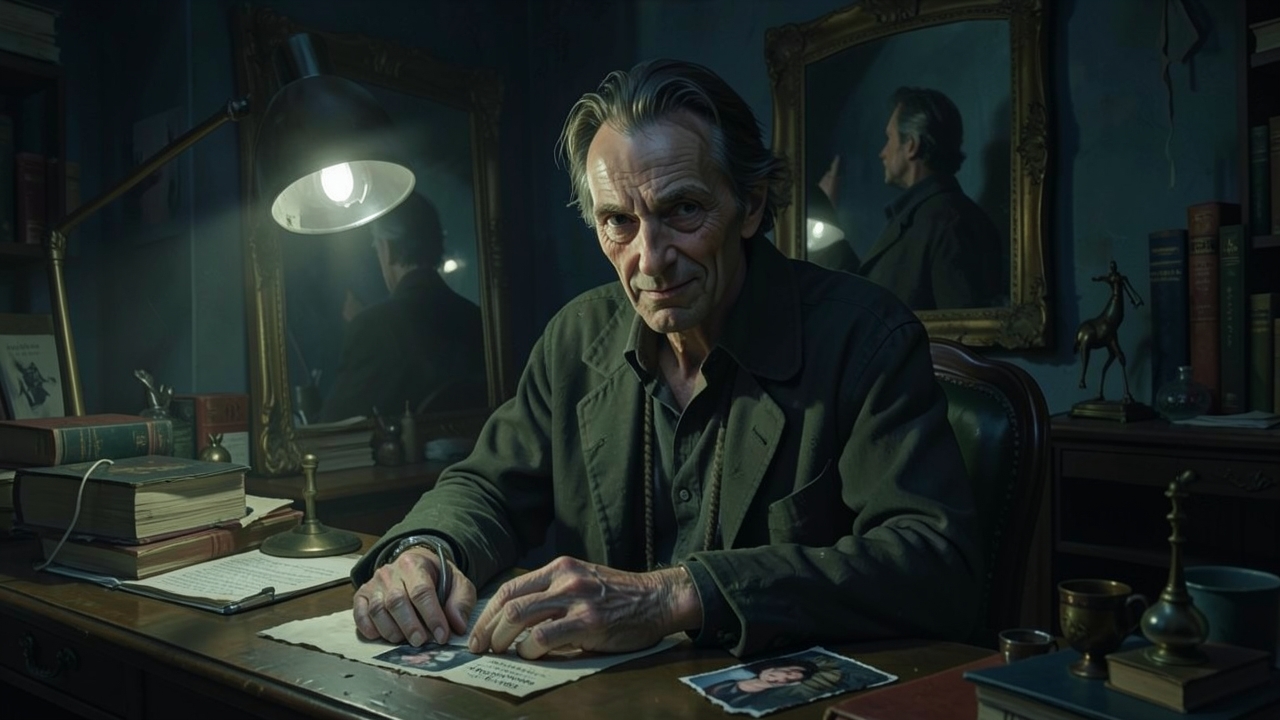
What specters haunt the mind of one who chooses to forget, not passively, but with deliberate, surgical precision? Who does not merely misplace a memory, but actively forges a new one to bear the weight of an unbearable present? This is the unreliable historian, a narrator whose backstory is a living fiction, meticulously crafted to serve a purpose—and to unravel their world.
The Anatomy of Deliberate Deception
The common unreliable narrator misremembers or interprets events through a flawed lens. Think of Stevens in Kazuo Ishiguro’s The Remains of the Day, whose denial is a form of passive self-protection. However, our subject is more proactive. This narrator is an author of their own origin story. They do not twist the truth; they replace it entirely. Consequently, their unreliable backstory is not a symptom of psychological weakness, but a weapon of psychological survival.
This active fabrication serves a crucial narrative function. It makes the character’s present actions understandable, even sympathetic, to the reader—at least initially. For example, a character who claims a noble, impoverished childhood may be excusing their current ruthless greed. Therefore, the false backstory acts as a moral alibi, one the writer must plant with care.
Motivation: The Need the Lie Serves
Every fabrication must have a purpose. Is the lie designed to garner sympathy? To claim a status they feel they deserve? To hide a profound shame or trauma? In Gillian Flynn’s Gone Girl, Amy Dunne doesn’t just invent a backstory; she stages an entire performance of victimhood. Her manufactured history as the perfect wife is a meticulously designed trap. Therefore, your first task is to define the precise emotional or practical need the false backstory fulfills.
The Craft of Weaving the False Tapestry
To make the fabrication believable within the narrative, the writer must master several techniques. First, use selective detail. A liar doesn’t invent everything from scratch; they curate. They might place real, verifiable landmarks into their fake history to lend it texture and credibility. Second, employ emotional consistency. The false memory should align with the emotional state the narrator wishes to project. If they aim to appear hardened, their fabricated childhood will be filled with cold, stark imagery.
In addition, consider the narrator’s relationship with the reader. They are confiding in us, or so it seems. This creates a dark intimacy. We become co-conspirators in their lie. As Shirley Jackson demonstrated in We Have Always Lived in the Castle, a narrator’s charming, almost conspiratorial tone can make us complicit in their horrific distortions of reality.
When the Fabricated Backstory Fractures
The true plot engine, however, is not the lie itself, but its inevitable collapse. The most compelling tension arises from the cracks in the facade. External pressures—a person from the “real” past appearing, documents contradicting the tale—force the narrator into frantic, escalating repairs. This is where your plot ignites. The character must now defend their fiction with increasingly dangerous actions.
Furthermore, the internal cost is just as dramatic. The narrator begins to forget which memories are real. Their identity becomes a hollow echo chamber of their own design. They might start to believe their own lie, leading to catastrophic misjudgments when reality refuses to bend. This internal schism, this battle between the crafted self and the buried self, is the gothic heart of the story.
Pitfalls: The Over-Forged Narrative
Be wary of making the narrator’s deception too obvious too soon. The reader must be invested in the false version before the first threads pull loose. Also, ensure the true backstory, when revealed, is worth the deception. It must carry a weight that justifies the elaborate fiction. A trivial secret will disappoint; a devastating one will resonate.
As literary scholar Lucy Scholes explores, the unreliable narrator invites us to play detective. The pleasure lies in the gap between what is told and what is true. Your job is to make that gap a thrilling, terrifying abyss.
The Cartographer of Scars
I am the sole keeper of my lineage. My mother, I tell the students in my seminar, was a diplomat’s daughter, raised on the scent of foreign soil and rare paper. My father was a scholar of medieval texts, his hands perpetually stained with the dust of forgotten libraries. This history gives my opinions weight, my passion for archives a logical pedigree. It is a clean, impressive story. Today, a young woman with sharp eyes and a tape recorder sits across from me. She says she is writing a book on forgotten voices. Then she places a photograph on the table between us. It is faded, the edges curled. A woman stands outside a corrugated metal shack, her smile weary, her apron stained with grease. Beside her, a child with my eyes and a profoundly familiar frown. The woman is my mother. The address on the back is a factory town three hours north, a place of smoke and industry, not diplomacy. I smile. I tap the photograph with one manicured finger. “A remarkable find,” I say, my voice a calm, steady murmur. “But you see, this is precisely the kind of archival error I combat. This woman bears a passing resemblance, but her context is all wrong. The provenance is dubious.” I slide it back to her. “My mother never labored. Her hands knew only books, not machinery.” As I speak, a new memory rises, hot and unwanted. The smell of boiling oil. The shriek of a press. The burn on my own small hand, a secret constellation of scars I mapped over long ago with tales of falling from a library ladder. I feel the phantom heat on my skin. The young woman watches me, her recorder silently whirring. She doesn’t need to say she knows. I see the knowledge in her gaze. My beautiful, sturdy fiction groans under the weight of this new, metallic reality. I must build a better wall, higher and faster. I must forget, again, for the story to live.The Echo in the Empty Hall
The power of the unreliable historian lies in this terrible, creative act. They are not just lying to others, but attempting to edit the very source code of their identity. When you craft such a character, you are building a narrative time bomb. The plot is the slow, agonizing fuse. The explosion is the moment the fabricated past and the undeniable present collide.
Consider how the art of a great reveal relies on this precise tension. The reader’s journey is one of dawning recognition. We move from trust to suspicion, from sympathy to horror or, perhaps, to a deeper, more tragic understanding. As Poe taught us, the most profound terror often comes from within the mind itself—a mind at war with its own history.
So, you must ask yourself: when your narrator’s carefully constructed world finally shatters, what truth will stand in the ruins? And will it be more monstrous than the lie they tried so desperately to bury?